The Question I Used to Wait to Ask
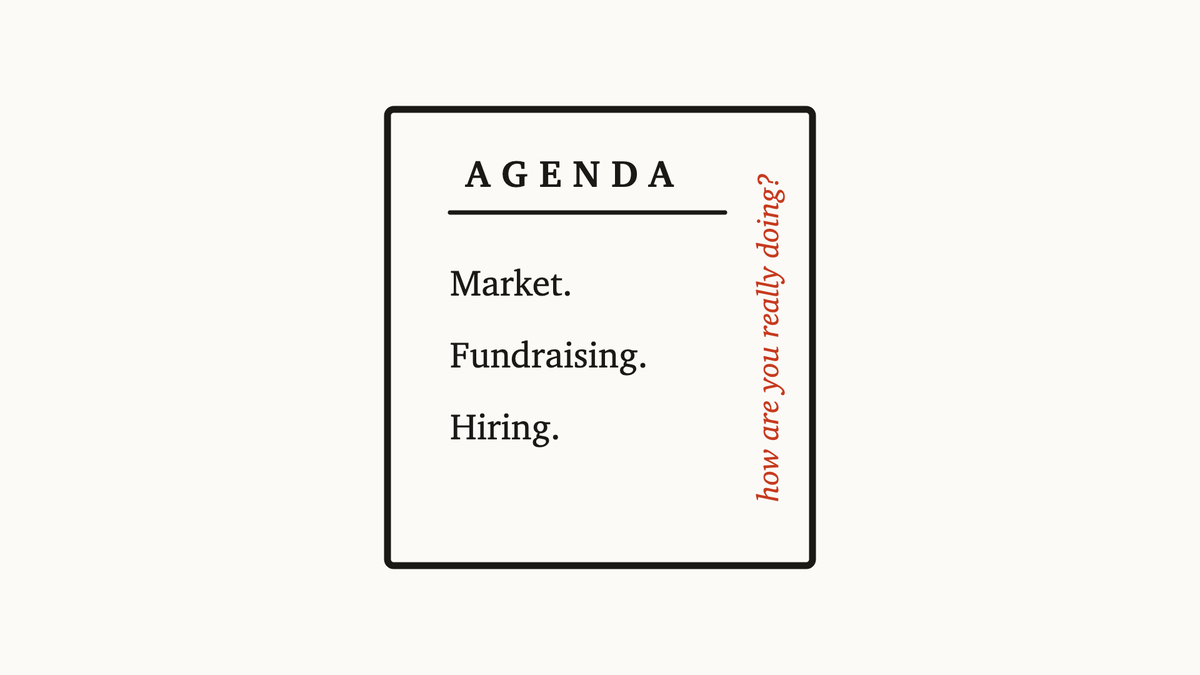
I'm three or four sessions into a new advisory engagement. Solo founder, building something really interesting. We've been working through the usual material - market positioning, the road to the next round, financial plan, a governance question or two. The conversations are productive. We're building rapport.
And somewhere in the middle of one of these calls, I notice something. Not in what they're saying. In what they're not saying. Not enough to name. Definitely not enough to ask about directly.
We're new in this thing together. I haven't earned that conversation yet.
So I don't have it.
It has bothered me ever since.
The advisor relationship gets built on a particular kind of trust. The strategic kind. You earn it by being useful on the things the founder hires you to be useful on - market, fundraising, hiring, the next milestone. The other kind of trust, the kind that lets you ask "how are you really doing," takes longer. Months, usually. Sometimes a year. By the time you've earned it, the founder may already be deep in something they can't easily climb out of.
I've been thinking about what to do with that timing problem.
Part of why I notice this at all is that I've been there myself. I've co-founded more than once. The one that taught me what I'm writing about here was a business I funded with my own money. After a period I genuinely enjoyed, the business hit serious trouble. I kept funding it from personal reserves longer than I should have - partly because I believed it could turn, partly because closing it meant accepting consequences for people who depended on the business. Employees, customers, partners. People who had trusted my read of the situation.
I couldn't sleep. Literally - not metaphorically. There were stretches where I would lie awake working through the same set of scenarios, the same set of people I felt responsible for. The financial weight was one thing. The weight of the people who'd trusted me was harder.
I eventually closed the business. It was one of the most difficult decisions I've made. I still believe it was the right one.
What stayed with me from that period was something my wife said, early in the difficult months, when she could see what was happening to me. "I realize that we are about to face an economic challenge. Our main task is to make sure that this doesn't become a health challenge or a family challenge. Economic adversity we can bounce back from."
I've returned to that line many times since. The point isn't to process the emotion or to find balance. The point is to keep the challenge from spreading. A business can be rebuilt. If it can't, you might move on to the next thing. Recovering from a marriage that quietly broke under the weight of the business, or a body that gave out, is a different problem entirely.
She was right, and she was one piece of what kept it contained. The rest had to be in place too.
The list isn't long, and it isn't rocket science. A spouse or partner who knows the true version of things, not the LinkedIn image. A close friend or two who stay close, including through the part where the founder pulls away. A therapist, maybe. A peer group, or a founders' support group, somewhere to talk without worrying about impressions. Lawyers and accountants who already know your situation. Real advisors or a board with standing - people whose job, in part, is to tell you what's actually happening.
Most of the founders I work with don't have all of these in place. Some have most of the pieces and don't use them, because they're managing appearance everywhere, including at home. Some never set them up at all.
You don't have to build all of this at once. Some of it - the lawyer who already knows your situation, the board with standing - is hard to assemble in the middle of a crisis, when trouble is clear to everyone you approach. Better to have those before you need them. A friend, a therapist, a peer group - if you don't have any of this yet and you're already feeling the weight, that's where to start. None of it requires capital. It just requires deciding it's worth doing.
Most of what I've described assumes prevention - building the structure before pressure arrives. That's where the leverage is, and it's how I try to frame the conversation with founders early in our work together. But it's not where most founders are by the time they're reading something like this. If you're paying attention to an article on the founder's mental load, you're more likely already inside it than thinking about prevention.
It usually starts in the body. Sleep goes first - falling asleep but waking at 3am, or not falling asleep at all. The body tends to know before the mind admits it. Then it shows up in your relationships: calls you're not returning, the doctor's appointment that keeps moving, a version of yourself you're maintaining across every audience including the people closest to you. And some of it is subtler. A flatness. An irritability without a real target. The sense that the work has stopped being interesting and is just something you're getting through.
If any of that sounds familiar, the first move isn't a system - it's smaller. Most of the founders I've watched come out of these stretches did the same thing first: they told one person the actual version. Not the team, not investors, not the LinkedIn presence. One person - a friend, a spouse, a peer founder, someone who could hear it without immediately needing to fix it. The conversation didn't solve anything in itself. It just stopped the carrying-alone. The rest of the structure usually started forming after that, because the silence was part of what was keeping it from forming.
Some of this silence is built into the role itself. Founders carry information about the true state of their company that they cannot fully share with anyone in their life. Employees get a version. Investors get a version. Co-founders get more, but rarely the whole thing. Spouses and partners often get the least, because protecting them from worry feels like part of the job.
It isn't a personality problem. It's how the role is built. Almost no other job comes with that combination - inside knowledge of existential risk plus an ongoing obligation to perform managed optimism in every direction. Surgeons and criminal lawyers carry weight, but they can talk to someone about the case in front of them. They aren't also the spokesperson telling everyone the situation is fine. The founder is the patient, the surgeon, and the spokesperson at once. That's the part that breaks people. The relationships I described aren't optional. They're how the role works.
Which brings me back to the timing problem from the start of this piece.
For a long time I treated "how are you really doing?" as a conversation that required earned trust. I held it back in early sessions because I hadn't earned it yet. The risk, as I now see it, is that by the time I've earned the right to ask, the founder is already deep in something I should have helped them prepare for.
I was asking the wrong question. The intimate version does require earned trust. But there's another version of the same conversation that doesn't.
"Tell me about your support system. Who do you call when you need to think out loud about something hard? Who knows the actual state of the company, not the version you tell investors? Do you have a therapist, a peer group, someone who's been there before? Are your professional relationships - lawyer, accountant, board - already in place, or are you going to need to build them in a crisis?"
That's a structural question, not an intimacy question. It can be asked early on. Most founders welcome it once they realize what's being asked. It isn't an invitation to confess. It's a checklist for something they probably haven't thought about systematically.
The decision I've made, working through this article, is that this conversation belongs near the very beginning of an engagement, not somewhere I wait months to feel it's OK to have. It's easier to ask "do you have these in place?" than "be honest, how are you really?" Both questions are about the same thing. Only one of them requires earned trust.
The founder I mentioned at the start - I'll see them again soon. I don't think I'll ask the question I almost asked last time. Not because I won't earn it eventually, but because I've decided I don't have to wait to earn it. The structural version of the conversation is one I can have now. That's where I'm starting.
Whether it makes a difference in this particular case I don't know yet. But the alternative is waiting, which may turn out to be too late.
I help founders navigate strategy and funding decisions when the path isn't clear. If you're there, let's talk.
If this was useful, I write one of these most weeks.
Subscribe on LinkedIn