The Generalist's Revenge
The Impossible Elevator Pitch
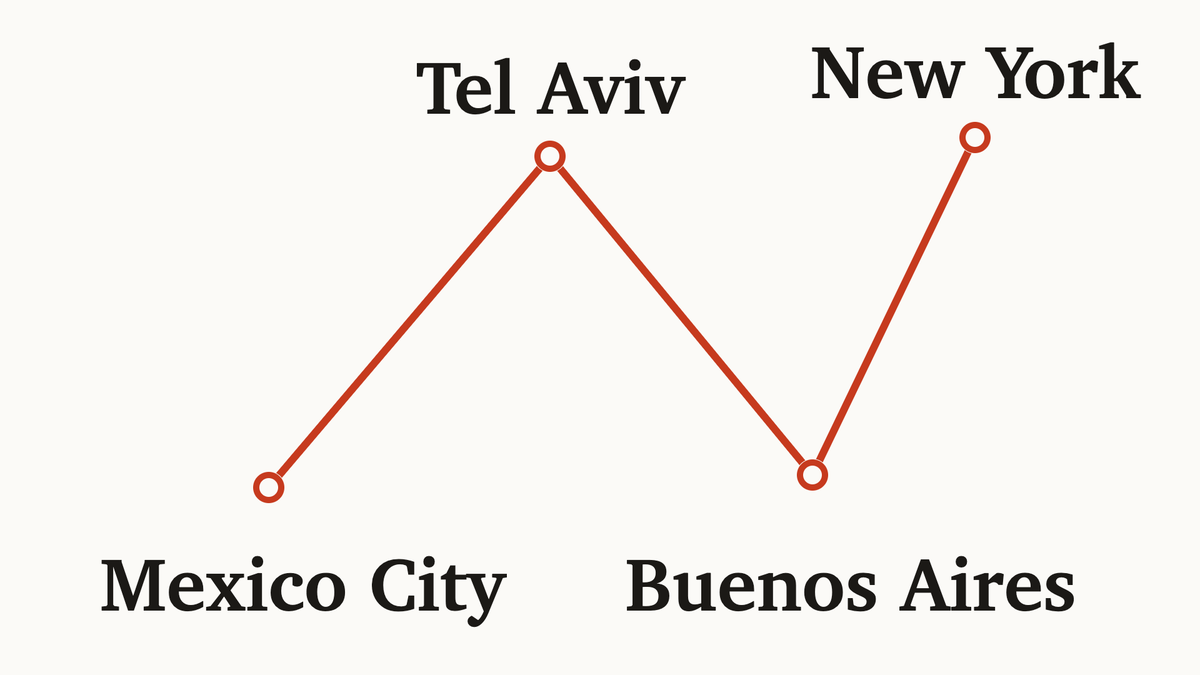
I'm 63 years old, and I still can't nail one simple question.
"So what do you do?"
Well, I went to kindergarten in Mexico City, elementary school in Tel Aviv, high school in Buenos Aires (won prizes for math and physics), and college in New York (but majored in music). I'm a jazz musician at heart, but my day job is in tech and venture. I've done business in telecom, enterprise software, mineral exploration, digital health, and pet-tech. I founded a music-tech accelerator, built and ran a corporate VC fund, and oh - I also started a social impact venture that employed hundreds of ultra-orthodox women in Israel. Last month I was evaluating mining technologies in Chile, this week I'm helping a music-tech startup prepare for a seed round.
"It's complicated," I say. "I do strategy consulting, but I also mentor startups, and I used to run a corporate VC fund, but before that I was in telecom, and actually I'm still involved in music tech, and..."
The familiar pause, then the pivot to someone with a simpler story.
For decades, my friends have offered the same well-meaning advice: "Eli, if you only had the patience, the discipline, and the focus - you could really be an expert in something."
They weren't wrong about what the world wanted. Every job posting demanded deep expertise. Every successful career seemed to follow a straight line. Specialists commanded premium rates while generalists got labeled as "unfocused."
But here's the thing - everything interests me, and I can't resist the opportunity to learn a new field.
When I was first asked by a London-based family office to help develop a novel mineral exploration strategy using the latest technology, I knew nothing about the field. I started with geology textbooks and industry reports. Six months in, I was building financial models for copper exploration. A year later, I was setting up a company in Chile, securing drilling rights, and learning about indigenous community relations. Two years in, I negotiated a complex agreement with Rio Tinto.
A few years later, an Australian pet-care giant approached me to help them form a CVC. The only thing I knew about the pet business was that we had two cats at home, Luna and Seamus, and that they occasionally needed food and vet care. I had no idea how large the market was or how fast it was growing.
Fast forward to me standing on stage at the Global Pet Forum in front of hundreds of industry leaders. I opened with two personal confessions: First, showing a clip of my band performing - "I'm actually a musician and this is my day job." Second, showing photos of Luna and Seamus - "Until recently, this was literally all I knew about the pet industry." The room laughed. Then they listened for 45 minutes as I walked them through the latest innovations reshaping pet care and what it meant for their businesses. From zero to keynote speaker - the generalist's journey.
Sure, I'm a quick learner. But what really gets me excited? Those messy problems where technology, money, people, culture, and timing are all tangled up in one giant knot. My greatest satisfaction comes from unraveling them.
But try explaining that at a networking event.
So much easier to say "I'm an expert in banking IT systems" or "I'm a marketing consultant for SaaS companies." Clean. Simple. Marketable.
I've spent years apologizing for my "scattered" background, trying to find my niche, wondering if I was just undisciplined. The musician who got distracted by business. The technologist who kept wandering into strategy. The consultant who couldn't stay in one industry.
Then I heard entrepreneur and author Ryan Levesque discuss something that made everything click. (His podcast "The Digital Contrarian" is worth checking out.)
The Moment It All Made Sense
In his podcast episode "The Rise of the Generalist," Ryan shared an insight from Lex Fridman's interview with Google CEO Sundar Pichai: "The industrial revolution created specialists; the AI revolution may reward generalists."
That hit the right note.
Ryan's key point: AI makes specialized knowledge accessible to anyone curious enough to learn, but humans excel at making non-obvious cross-domain connections that AI cannot. The winners of the new economy will be "cross-domain pattern spotters."
Huh. The world has finally caught up with me.
Maybe there was nothing wrong with me. Maybe I was just ahead of my time.
Let me explain what's actually happening here.
- When AI Changed the Rules
- Why Specialists Are Becoming Commoditized
Consider this: what took a specialist years to learn, AI can now teach someone in hours. When AI can generate working code in minutes, draft marketing strategies in seconds, and analyze complex datasets instantly, technical knowledge becomes the baseline, not your competitive edge.
I see this working with startups. Remember when you needed that one developer who knew everything about mobile apps? Or that marketing guru who'd spent decades perfecting email campaigns? Now founders are looking for something different. They need someone who can see how app architecture affects user adoption, how content strategy impacts customer success metrics, how technical decisions influence funding conversations. And crucially - they need someone who can quickly learn to implement these insights using AI tools that are evolving by the day.
In my recent piece "The Startup Playbook is Dead," I wrote about the need for "AI orchestrators" and "T-shaped generalists" - people who combine deep knowledge in one area with broad understanding across multiple functions. This isn't about knowing everything; it's about seeing how everything connects.
The Generalist Advantage
What I've noticed is that generalists excel at making non-obvious connections across domains.
My jazz improvisation background taught me about balancing written music with improvisation - principles that directly shaped how I help startups navigate between business plans and pivots.
The mineral exploration world operates on 70% (or less) information - waiting for 90% certainty means someone else gets rich. I use the same framework evaluating startups - perfect data doesn't exist, but patterns do.
When implementing critical systems at a major telecom, I learned that the hardest part of scaling isn't the technology - it's getting different departments to work together. I see the same challenge when startups hit their first growth inflection point.
This is what AI can't replicate - using diverse experiences to solve problems in new ways.
My Three Superpowers:
Being the translator: I speak technical and financial, creative and corporate, startup and enterprise. Also English, Spanish, and Hebrew - which helps. That Chilean mining venture? London financiers needed rigorous financial plans before investing millions. Israeli technologists in shorts and sandals had wild ideas about using bleeding-edge tech. Chilean mining executives didn't trust foreigners and expected suits, ties, and fluent Spanish. Someone had to wear the suit, understand the deep-tech talk, and present McKinsey-grade financial plans.
Connecting the dots: I see how separate pieces fit together to reveal patterns others miss. When managing a portfolio of startups in our CVC, this meant connecting different data points - internal and external - to identify trends, threats, and opportunities. Market conditions shifting, clinical study results that are "so-so," a burn rate that isn't sustainable, founder dynamics that aren't healthy - when you connect all these dots, it becomes clear it's time to step back rather than double down.
Spotting the patterns: I recognize the same problems wearing different costumes. The politics that kill corporate innovation? They mirror the dynamics that break up co-founders. The way mining companies allocate exploration budgets? It's a similar decision framework startups should use for experimenting with new channels. When I was hired as Risk Manager for a bank merger, I had to identify risks early across dozens of different areas - but the underlying patterns of institutional risk were the same ones I'd seen in telecom transformations and startup scaling challenges.
The Era of Messy Problems
We're entering an era where the problems that matter most require cross-domain thinking. Climate change. AI's impact on society. Geopolitical risk. Startup building in uncertain markets. These challenges don't respect disciplinary boundaries - and neither can their solutions.
That's why the most interesting work happens at intersections. Where deep specialists meet broad connectors. Where different industries share lessons. Where cultures and generations bring different pieces to the same puzzle. The magic isn't in any single expertise - it's in the unexpected connections between them.
So what does this actually mean for people trying to navigate this new landscape?
What I Tell People Now
I've been thinking about what this means for people trying to navigate this new landscape - founders, investors, corporate executives, people wondering about their own careers. Here's what I've seen:
If you're building a company, specialists aren't what you need for every function early on. The founders I work with look for connectors who can wear multiple hats and see how decisions ripple across functions. People who can learn new tools and domains as needed. Their diverse backgrounds become unfair advantages, not weaknesses.
If you're an investor or advisor, that founder with the "scattered" resume might be exactly who can navigate the complexity ahead. Narrow specialization gets commoditized by AI while weird combinations of experiences become the moat. The pattern recognition consultants I know are thriving. The messier the problem, the more valuable they become.
If you're a corporate executive trying to drive innovation, you might find more value in translators who can get your departments talking to each other and bridge the gap between startup agility and enterprise reality. The connectors who see the bigger picture, people whose diverse backgrounds let them spot opportunities others miss - these might be your secret weapons.
And if you're navigating your own career, wondering if you should "finally focus" - maybe don't. The Renaissance people are making a comeback. The ability to synthesize across domains becomes a premium skill. "Curious generalists who can learn anything" will create more value than "experts who know everything about one thing."
The most interesting people I know aren't the deepest specialists - they're the best connectors. They see patterns others miss because they've been looking across domains their entire careers.
But it took me years to figure this out.
It Wasn't Always This Clear
In my thirties, I constantly apologized for being "unfocused." I tried forcing myself into specialist boxes that never quite fit, always feeling like something was wrong with me.
By my forties, I'd learned to package my generalist skills as "strategic consulting" - still hiding the breadth, but starting to see it might actually be valuable.
In my fifties, the shift became clear. My cross-domain experience was the actual value, not a side effect. Clients hired me specifically because I could navigate complexity others couldn't.
Now in my sixties, the AI era is validating everything I've intuitively known - that connecting dots matters more than specialization.
I still introduce myself as "actually a musician - this is my day job" because it immediately breaks the ice and shows I come at things from a different angle. Music requires real-time collaboration, pattern recognition, and the ability to create something beautiful from structure and improvisation. These aren't side hobbies; they're core business skills. (You can hear for yourselves here.)
So what's the bottom line after all these years of never quite fitting the mold?
The Bottom Line
I'm not advocating against all specialization. Deep expertise still matters. But I've learned that your "scattered" background isn't something to fix. It's something to leverage.
Your seemingly unrelated skills, your cross-cultural experiences, your "inability to focus" - these might not be bugs in your career operating system. They might be features.
I've finally stopped apologizing for my diverse background. Instead, I lead with it. When I need to introduce myself, I say: "I'm Eli Hasson. I solve problems."
If this was useful, I write one of these most weeks.
Subscribe on LinkedIn