Part III: You're Pitching the Wrong Rooms
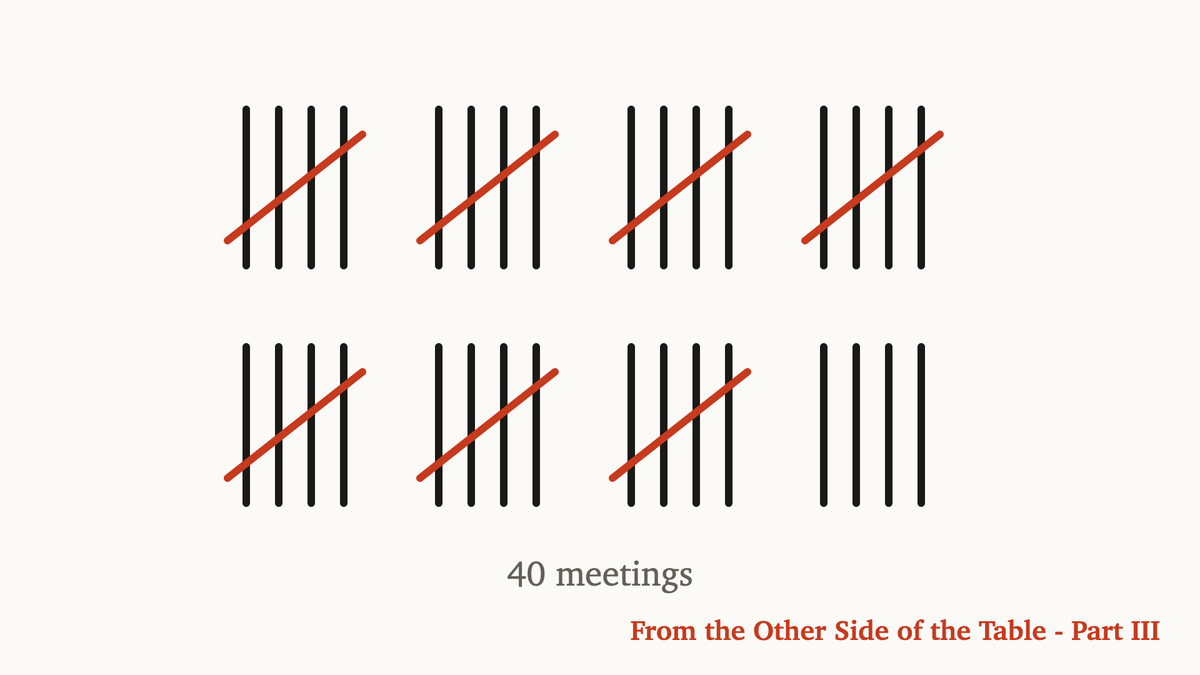
I recently met a founder I haven't seen in a while. He is raising a seed round, interesting product, strong team. He had booked 40 investor meetings - the kind of number that looks like progress - and collected 35 no's. By the time we spoke he was questioning everything: reworking the financial plan, second-guessing the team, certain the company was the problem.
The company was fine. I had looked at it closely; it could raise. The problem was the list. Most of those 40 investors were never going to fund a business like his - wrong stage, wrong sector, wrong geography - and a good number of the no's were decided before he opened his mouth. He had spent his best energy, and a chunk of his confidence, on rooms that were never going to say yes.
In Part I I wrote that when an investor passes, the first job is to work out which no it was - about the company, or about you. There's another thing sitting underneath both, and it's the one founders skip: you chose who to reach out to in the first place. The pitch is what everyone obsesses over. The list is what actually decides most of it.
The funnel, and the wisdom worth questioning
The standard advice is to go wide. Fill the funnel, take every meeting, work every warm intro, because you only need one yes and you can never be sure which room it comes from. The advice isn't wrong - I've watched the unexpected yes come from a room nobody would have shortlisted, and a pipeline that's too thin can hurt a perfectly good company.
But "go wide" quietly assumes the meetings are free. They aren't. A no costs energy, and confidence, and if the list is long enough, conviction itself. The first rejection is a data point. The twentieth, in a bad week, can convince a perfectly fundable founder that the company is broken, and send her off fixing things that were never broken. That cost is invisible on a pipeline tracker, so it never makes it into the advice.
What I've seen work better, for most founders, is a narrower funnel: a short list of investors who actually fit - right stage, right thesis, right sector - and the discipline to skip the rest, including the flattering meetings that go nowhere. Not because volume never helps, but because a chosen list protects the one asset the wide funnel spends without noticing: your conviction, walking into the rooms that count.
Working out who actually fits is less mysterious than founders expect. Have they written checks at your stage in the past year? Are there companies near yours in their portfolio - close enough to understand you, not so close you're a conflict? Have they ever led in your category, or do they only follow? An hour with a fund's portfolio page and its recent announcements answers most of this. Most of my founder's list wouldn't have survived that hour.
A narrower funnel still has an order
Choosing a shorter list settles who you pitch. It doesn't settle the sequence - and the sequence matters as much as the list.
Nobody's pitch is sharp on the first meeting. In my experience it takes three to five real investor conversations before the thing actually clicks - before you find the right tone, the answer to the question that keeps catching you, the version of the story that flows naturally. You don't get there rehearsing in the mirror; you get there live, a few times. The only question is who absorbs the cost of those first few rough runs.
So here's the part that sounds backwards and isn't: even on a narrow list, your first meetings probably shouldn't be your highest-ranked investors. The founders I've seen run this well rank the list, then deliberately open with the ones lower down - the plausible-but-not-perfect fits - and let those be the rehearsal room. By meeting four or five the pitch is sharp, and that's when they walk into the investors they actually want.
Run it the other way and your best-fit rooms become the practice rooms - the partners who know the space, whose check you most want, watching you fumble the answer you'll have nailed a week later. That's the one mistake the narrow funnel doesn't forgive: you don't get those rooms twice.
Generalist or specialist - and what each one is really worth
Once you're choosing rooms on purpose, the next question is what kind. The split that matters most, especially in a niche, is specialist versus generalist.
A sector specialist needs no education. In pet-tech, the investor who already knows the category understands why your wedge matters, what the unit economics should look like, who the acquirers are - you skip the translation entirely, and they tend to move faster. The catch is that in a niche like pet-tech there simply aren't many of them. You can't build a whole raise out of specialists who don't exist in sufficient number.
A generalist needs a translation layer - and founders consistently underestimate how much. You'll spend meetings teaching the category before you can pitch the company, and some generalists will never get there. But the good ones bring something the specialist can't: a cross-domain read, patterns from twenty other markets, the question nobody inside the vertical would think to ask.
Reading which room you're in is its own skill, and I've sat through both versions of getting it wrong. Founders who pitched a generalist as if the category explained itself, and lost the meeting to confusion. And founders who sat across from me - by then years inside pet-tech - and spent their first ten minutes proving the pet market was large and growing. I knew that. Everyone at the table knew that. Half the pitch is knowing what the room already knows - and the fix is cheap: ask, before you pitch, how well they know the category.
The mistake I keep seeing is choosing on speed - taking whoever says yes fastest. The founders who got this right chose on what the investor adds to the cap table. A specialist brings industry doors and best practices; a generalist, wisdom from outside the bubble you're stuck in. The question worth sitting with is what your company actually needs - and whether you're letting the fastest yes decide it for you.
The strategic investor, with open eyes
One kind of investor deserves its own warning: the strategic - the corporate fund, the would-be acquirer with a venture arm.
I ran one of these for six years, so I'll be straight about both sides. A strategic on your cap table is validation you can't buy and doors you couldn't open alone - the logo tells the market someone who knows the industry believes you. That's the bright side, and it's real.
The other side arrives later. A strategic can complicate a cap table in ways a financial investor doesn't, and it can quietly narrow your exits - because the moment one industry player owns a piece of you, their competitors start to wonder what they'd be buying, and how much of it already belongs to a rival. The same investor that opened doors can close others you didn't know you'd want. Mars, to take the obvious pet example, is both the most credible investor in the category and one of its largest acquirers - which is why a stake like that deserves thought on both axes, not just the validation.
None of this means refuse the strategic. It means take it with open eyes, and not for the logo.
The list is the strategy
Put it together and the conclusion is uncomfortable for anyone who has spent three weeks polishing a deck: who you approach, in what order, and who you let onto your cap table is a more consequential set of decisions than how you pitch. The pitch is the part you can see, so it's the part you fix. The list is the part that quietly decides the raise.
Which brings me back to my founder. We met again and went through the original list, name by name, with one question: was this investor ever going to fund this company? For roughly 80% of the list, the honest answer was no. We pruned what was left, added a few names that should have been there from the start, and put them in order. Somewhere in that hour the energy in the room changed - the 35 no's stopped being a verdict on the company and became what they had been all along, the cost of a list nobody had questioned.
He's back out there now - fewer meetings, better rooms, chasing the right yes instead of any yes. I don't know yet how his round ends; that part is his to write. What I know is that he walked back in with the same company and a different list, and the meetings are finally about the business. The pitch barely changed. The rooms did.
I help founders navigate strategy and funding decisions when the path isn't clear. If you're there, let's talk.
If this was useful, I write one of these most weeks.
Subscribe on LinkedIn