Part I: You're Fixing the Wrong Thing
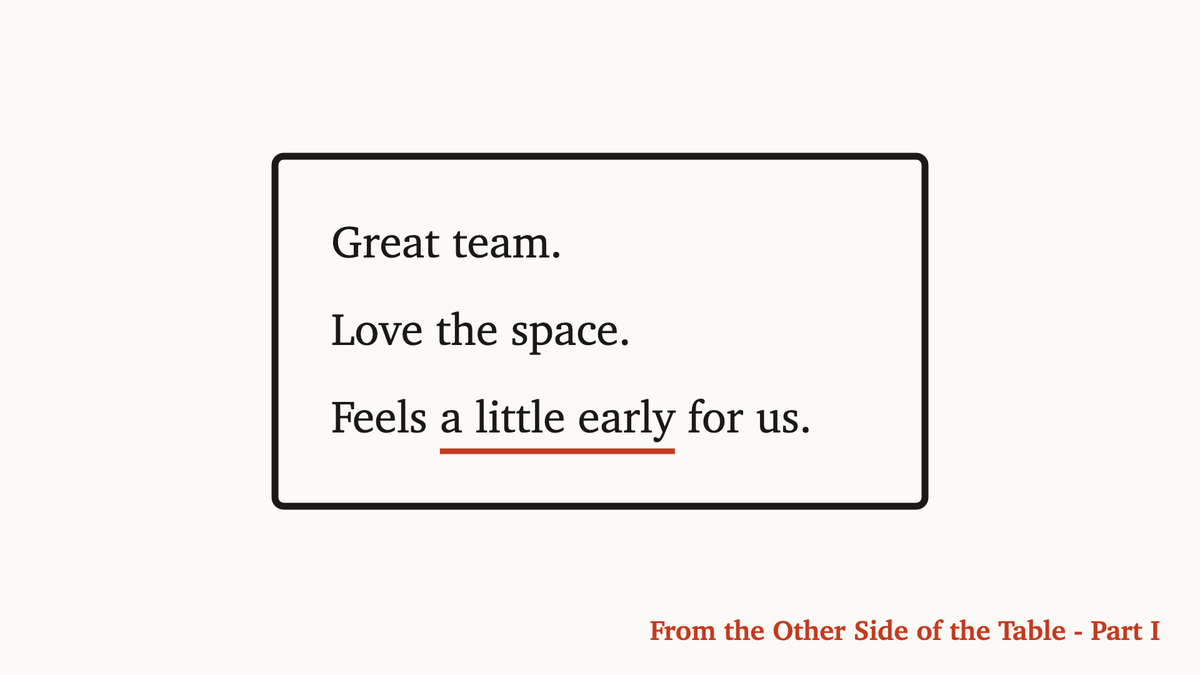
A founder I work with forwarded me a rejection email last month. She's building a wellness app, out raising her seed round. Three lines from the investor: great team, love the space, but it feels a little early for us. She read it as a soft "no", and by the time we spoke she had already started rebuilding the deck - new slides, a bigger market, a tighter story.
I asked her to stop. Not because I thought the deck was perfect. Because she had no idea what she was actually fixing.
"Too early." "Not ready." "A bit early for us." I heard versions of that sentence for years, and said them myself. For six years I built and ran a corporate venture fund in pet-tech, evaluating startups and sitting on the boards of the ones we backed. Most of what I've watched founders get wrong about fundraising starts with misreading what's happening on the other side of the table. So let's start with the most common misread of all: what a "no" actually means.
Two very different "no"s
When an investor says you're not ready, they mean one of two completely different things. Either it's about the company, or it's about you. Those aren't the same problem, and they don't have the same fix - which is a problem in itself, because the rejection email looks identical either way. Three polite lines that could mean anything.
Sometimes it's about the company, not about you. Usually that means fit - you're a fine business, just not for this investor. Wrong room, wrong thesis, nothing that reflects on you, and the same pitch that gets a "no" here gets a "yes" down the hall. Sometimes it isn't fit but stage - the company is real, just not far enough along yet, and the investor is telling you so. Either way nothing about it reflects on you, and the part founders forget is that a "no" like that often isn't even permanent. Go back to the same investor in six months, further along, and "too early" quietly turns into "let's talk."
Sometimes it's about you. The company is fundable - but you weren't ready to be in the room. The story has holes. The model falls apart the moment someone leans on it. You had a good answer to the first question (the one you rehearsed) and nothing for the second. A company like that can raise. Just not with a founder who hasn't done the work yet, and this month, that founder was you.
Pet-tech made this easy to get wrong. It's a personal business - almost everyone is building for an animal they love - so a "no" feels personal even when it isn't. I watched app founders take "too early" to heart when all it meant was that the bar had moved and a charming demo no longer cleared it.
One of them is expensive
The two bear completely different costs, which is why guessing wrong is so expensive.
A "no" about the fit is the cheap one, if you recognize it. You lose a meeting and an afternoon, and you may well get another shot at the same investor later. The damage only starts when you mistake it for the other kind and start "fixing" a company that was never broken - widening a niche you should have owned, rewriting the plan around a single comment from someone who was never going to invest. I've watched founders take a perfectly good company apart chasing the approval of the wrong person.
A "no" about you is the one that lasts. Lose a meeting because you weren't on top of your numbers, and you don't only lose that investor. Word travels, and the investor world is far smaller than it looks. "Saw them, the numbers didn't hold up" gets around. You can always raise money again. What's hard to rebuild is the impression, once an investor has it, that you don't really know your own business.
The work nobody cheers for
If the expensive mistakes happen in the room, you'd expect founders to pour their energy into being ready for it. Most do the opposite. They put maybe 80% of their effort into getting meetings - the intros, the lists, the follow-ups - and 20% into being ready for the ones they get.
Part of it is that getting a meeting feels like progress. It's visible, it's social, you can count it: 12 intros chased, 6 calls booked. Being ready is invisible work that nobody cheers for, so it quietly loses the competition for your time. Then the meeting you fought so hard for arrives, and you walk in unprepared.
But meetings aren't the scarce thing. There's always another introduction. What's scarce is your credibility in the few rooms that actually matter - the investors who know your space and would make the right partners. Walk into one of those underprepared and you don't just lose a meeting; you spend a piece of a reputation you'll want later. The founders who raise best tend to flip that ratio - they treat a first meeting as something you earn by being ready, not something you chase and then cram for the night before.
A "no" is information
So when the "no" comes, and it will, plenty of times, the skill isn't brushing it off - but neither is it taking it to heart. It's reading it, and taking the right lesson from it. A "no" is information, if you bother to decode it.
The first kind - the one that isn't about you - comes in more than one form, and the work is telling them apart, because they don't all point to the same next move. Sometimes it's a roadmap: here's the exact thing to go build before you come back. Sometimes it's a door left open: not now, but when this or that thing is true - and the investors who say that usually mean it, so keep them close. And sometimes it just tells you this was the wrong investor - the wrong fit, or someone who was never going to write the check - and the lesson is about who you're pitching, not about your company.
And then there's the other kind. Sometimes the "no" is about you - which is the most useful one of all, if you can stand to hear it. It's also the hardest, because it's the one your ego prefers to deny. We would all rather believe we met the wrong investor than admit we walked in not ready. So the harder move is to ask the uncomfortable question before you reach for the comfortable answer: was there a question I couldn't answer, a number I fumbled, a part of my own story I hadn't thought through? If there was, that "no" just handed you your to-do list. Close the gap, and the same investor who passed will often take a second meeting - because little impresses someone on this side of the table more than a founder who comes back visibly sharper than the one they turned down.
The founders who raise well aren't the ones who hear fewer "no"s. They're the ones who learn the right thing from each one.
So, which one was it?
Back to the founder I started with, and her rejection email. I told her the email wasn't going to answer the question for her - three polite lines never do. So before she touched the deck, I asked her to walk me back through the meeting: the questions they asked, the ones she didn't have good answers for, the moment where she felt the room cool. That's where the answer lives, if it lives anywhere. Was that "no" about the company, or was it about her?
And that's the hard part: it's almost impossible to answer honestly about yourself. The part of you that wants the answer to be "wrong investor" is the same part doing the deciding - so that's the answer you reach for, and you go off and rebuild a deck that was never the problem. It isn't that the question is hard. It's that you're standing too close to see it.
She didn't love the question. But it's the only one that tells you what to do next - fix it, wait, or walk away. Because the expensive mistake in fundraising isn't getting a "no". It's rebuilding the wrong thing because you misread the signal.
I help founders navigate strategy and funding decisions when the path isn't clear. If you're there, let's talk.
If this was useful, I write one of these most weeks.
Subscribe on LinkedIn