Build Slow, Move Fast
The strategic preparation founders skip - and regret
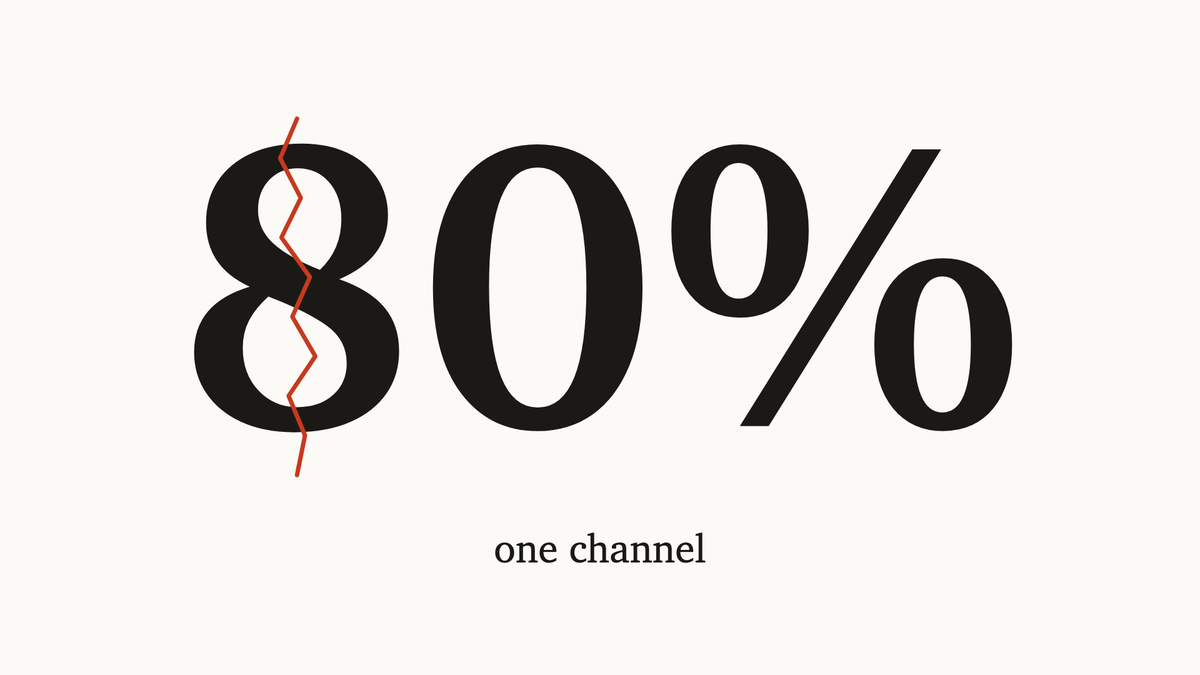
A founder I'm working with gets 80% of her customers from one channel. Everything seems to be working fine - CAC under control, predictable flow, consistent growth. Last week I suggested we devote our next call to mapping alternatives. What happens if the costs spike? If the platform changes its rules? If a competitor floods the channel with ad spend?
Her response: she doesn't have time for that. There are three more urgent topics we need to cover - a partnership negotiation, a hiring decision, a product question from a key customer. Can we push the channel strategy discussion to next month?
She's not wrong. Those three things are real and pressing. But I've watched founders wake up to find their entire acquisition engine gone overnight - an algorithm change, a policy update, a cost shift that broke the unit economics. The time to build alternatives isn't when you're desperate. It's when you don't need them yet.
Why founders resist (and why they're partly right)
Let me be clear: the pressure founders feel to move fast isn't manufactured. It's survival.
Investors want velocity. Peers are shipping. The entire startup ecosystem screams "execute now, optimize later." And there's truth in it. The lean startup movement is correct about operations - building headcount, processes, and systems before you need them burns cash without generating learning. Startups that over-plan and under-execute lose to startups that ship and iterate.
I've seen founders paralyzed by planning. Endless strategy sessions while competitors grabbed the market. Perfect documentation for a product nobody wanted.
So when a founder tells me "I need to execute, not plan" - I hear that. They're responding to real incentives. Every hour spent on contingencies is an hour not shipping, not selling, not solving today's crisis.
But here's what the "move fast" orthodoxy misses.
What you can't build under pressure
Not all preparation is the same. Some things can be built just-in-time. Need a CRM? A week. Ticketing system? A month. New hire? Two to three months. Build these too early and you're burning cash on overhead you don't need. Build them too late and you'll have some painful months, but you can catch up.
Other things can't be rushed.
Board relationships where there's actual trust - not just names on paper, but people who know your business well enough to help in a crisis. Advisor relationships where someone can give you honest feedback because they've watched your decisions over time. Founder alignment on hard questions - equity, decision rights, what happens if one of you wants out. Your own clarity on quit criteria before you're desperate. Governance literacy before term sheets arrive. Channel alternatives before your primary channel shifts.
The setup time for these exceeds the decision window. You can't call an advisor the week you need them and expect useful help - they don't know you or your business. You can't build board trust during a crisis - trust comes from months of honest communication. You can't align with your co-founder on exit scenarios when you're already arguing about an offer.
That's the trap. The lean startup advice is right about operational infrastructure. It's incomplete - sometimes painfully so - about strategic infrastructure.
What slow-moving industries understand
I spent years in telecom and mineral exploration - businesses that think very differently about preparation.
In telecom, you don't wait until the network is at capacity to plan expansion. You build for overcapacity. You invest in redundancy before you need it. Because when the network goes down, you can't pause operations while you figure things out. The cost of unplanned downtime is catastrophic.
Mineral exploration operates similarly. Before you commit serious capital to drilling, you've already done geological surveys, secured land rights, built relationships with local authorities and communities, negotiated partnerships with larger players. The preparation takes years. By the time you're ready to drill, most of the strategic work is already done.
I saw the same principle from another angle when I consulted for an Israeli bank during a post-merger integration. Banks invest heavily in risk management - methodologies, processes, dedicated teams. It can look like bureaucratic overhead. But that discipline forces you to think systematically about what could go wrong before you're in crisis. Sometimes it helps you avoid the problem entirely. Other times, the risk is unavoidable - but when it hits, you're not scrambling. You've thought through the scenarios. The crisis is still a crisis, but it's a crisis you're prepared for.
These industries move slowly for good reason. Capital intensity and regulatory pressure force long-term thinking. You can't build a mine just-in-time. You can't manage systemic risk reactively.
Startups are different - they should move fast on operations. But some things in startups are more like building mines or managing bank risk than shipping features. Strategic infrastructure has setup time that can't be compressed.
So how do you apply that mindset when you're moving at startup speed?
Drivers and navigators
Here's an analogy I keep coming back to.
Founders need to be excellent drivers - managing potholes, road closures, flat tires. Reacting in real time. Hands on the wheel, eyes on the immediate road. The startup ecosystem trains founders to be drivers. Move fast. React. Adapt. Execute. That's essential - bad drivers crash.
But they also need to be navigators. Know the destination. Understand which roads exist. Have contingencies for when the main route is blocked. Carry extra fuel in case something goes wrong.
Driving is real-time. Navigation is preparation. Both are essential, but they happen on different timescales. You can't navigate while swerving to avoid an obstacle - but if you haven't navigated in advance, you might swerve onto a road that leads nowhere.
The founder I mentioned at the start? She's an excellent driver. Handles every crisis, closes every deal, ships every feature. But driving without navigation means moving fast with no idea whether you'll have options when the road closes. That's why I insisted we have the channel conversation - not because I enjoy being the person asking about contingencies when everyone wants to talk about growth, but because someone needs to insist on navigation while there's still time to navigate.
How to tell the difference
The practical question: how do you know which preparations can wait and which can't?
Here's the filter I use. Ask yourself two questions about any potential preparation:
How long does this take to build? Some things can be stood up in weeks. Others take months or years. Board trust, advisor relationships, founder alignment, governance literacy - these have long setup times. CRMs, ticketing systems, process documentation - these can be built quickly when needed.
What's the cost of being unprepared? This is the critical question. Some gaps are painful but survivable. Others are fatal.
If customers are unhappy and you need to build a ticketing system, the cost of doing it just-in-time is a few angry customers. Painful, but you'll recover. If a sales opportunity appears in a territory where you have no presence, you might lose three months of sales while you get someone on board - and you as founder can probably mitigate much of that anyway. These are operational gaps. They hurt, but they don't kill you.
Strategic gaps are different. If your primary channel collapses and you have no alternatives, that's not three months of pain - that's an existential threat. If a term sheet arrives and you don't understand governance provisions, you might sign away control you can never recover. If your co-founder wants out and you've never discussed exit scenarios, you're negotiating the future of your company in crisis mode. These gaps can be fatal. And unlike operational gaps, founders can't personally mitigate them through heroic effort.
When setup time is long and the cost of being unprepared is severe, you're in strategic infrastructure territory. Build it before you need it, or accept that you won't have it when you do.
The channel concentration founder? Alternative channels take 3-6 months minimum to build - testing, optimizing, developing playbooks. The work itself isn't complicated: identify 2-3 potential channels, run small tests with modest budget, develop enough data to know they're viable. The hard part is making time for it when the primary channel is working fine. But if that primary channel breaks without alternatives in place, that's not lost sales for a quarter. That's potentially the end of the company. The math is clear. The conversation can't wait until next month.
What I learned watching it go wrong
I sat on the board of a company in our pet-tech portfolio. During one meeting, I raised their customer concentration - one enterprise deal represented over 40% of projected revenue. The founder acknowledged the risk but said they couldn't afford to slow the deal while building alternatives. Fair point. The deal was moving.
Six months later, the client's parent company was acquired. New management killed all partnerships, including ours. The company was left with a product built for one customer who no longer existed.
The founder made a reasonable call given the pressure. But watching that unfold is why I was firm with the channel concentration founder. Same pattern, different context. Setup time exceeds decision window. The conversation can't wait until next month.
Why I create friction
Here's what I've come to understand about the work I do: the urgent doesn't need my help. It has plenty of advocates. Urgent problems force themselves onto the founder's desk. They demand attention. They come with deadlines and consequences and people asking for updates.
The important-but-not-urgent has no such advocates. It keeps getting pushed. Next month. Next quarter. After this round closes. After we hire the VP. There's always a reason to defer it.
That's where I come in. Part of my job is to be the advocate for the stuff that keeps getting deferred - the strategic preparation that feels optional when things are working but becomes the only thing that matters when they're not.
I've been in enough rooms. I've watched founders hit walls they could have seen coming. Not because they were stupid - because they were focused on execution, which is exactly what everyone told them to do.
I've also seen founders who did the work. Who thought about quit criteria before they were desperate. Who understood their term sheet before they signed it. Who had channel alternatives mapped before they needed them.
The ones who did the work navigated better. Not always. Not perfectly. But better.
Maybe I'm wrong about how much this matters. Maybe the founders who skip strategic preparation and survive anyway are proof that it's not essential. But that's not what I've seen. And until I see differently, I'll keep creating friction - keep insisting on the navigation work while there's still time to navigate.
The founder with channel concentration? She agreed to the conversation. We're mapping alternatives next week.
That feels like progress.
I help founders navigate strategy and funding decisions when the path isn't clear. If you're there, let's talk.
If this was useful, I write one of these most weeks.
Subscribe on LinkedIn