Beyond Product-Market Fit: The Four Fits Every Startup Needs
TL;DR: The Critical Framework
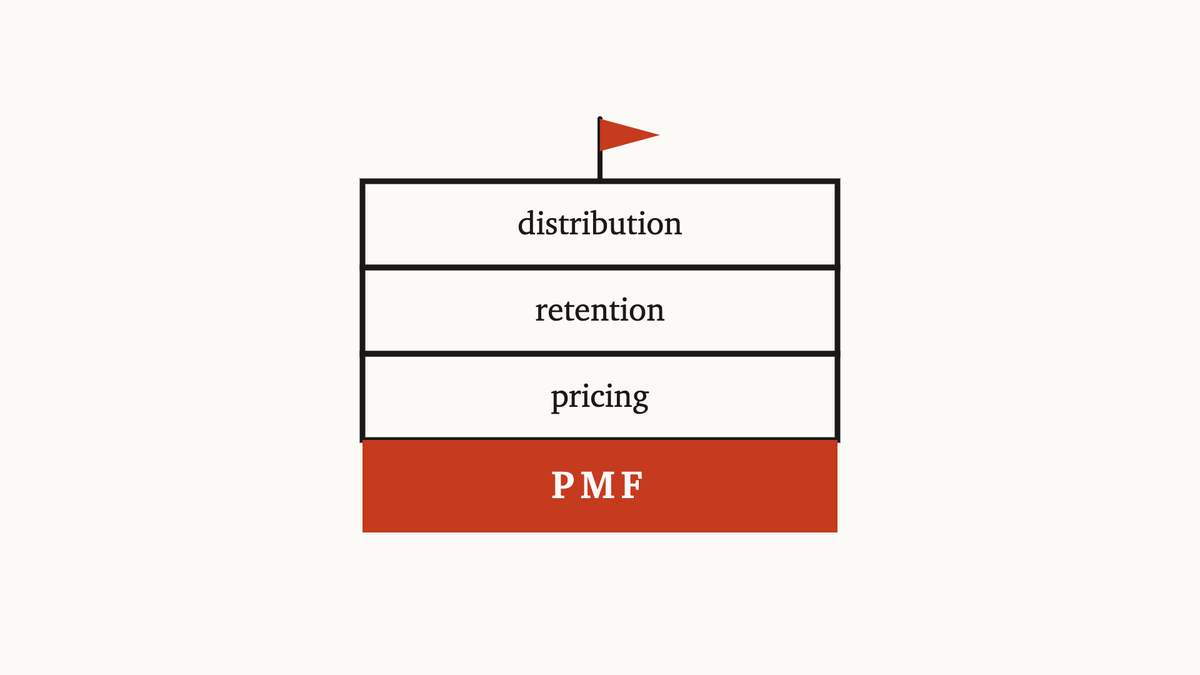
Product-Market Fit is checkpoint one, not the finish line - AI made reaching PMF faster; the real work is building the three layers that come after.
Four fits must be stacked in sequence - Product-Market Fit → Distribution-Market Fit → Model-Market Fit → Team-Model Fit. Skip a layer and your structure collapses.
AI intensified the challenges - Product development got easier, but distribution became harder, competition faster, and organizational complexity greater.
Small market success can mislead - Early traction through founder network and local advantages doesn't prove you can distribute at scale in different contexts.
Navigate at 80% confidence - When you're 80% confident on current fit, start preparing for next layer. The skill is maintaining focus on today while building foundation for tomorrow.
Investors look for awareness, not answers - At seed stage, they want evidence you've thought about these transitions, even if you haven't solved them yet.
Why Product-Market Fit Isn't Enough
For years, the startup narrative has been clear: find product-market fit and you've made it. Get customers pulling your product out of your hands, see organic growth, hit those retention numbers - that's success.
Except it's not. It's checkpoint one.
Marc Andreessen defined product-market fit as "being in a good market with a product that can satisfy that market." You know you have it when usage grows as fast as you can scale it, money comes in without heavy pushing, word-of-mouth spreads naturally.
But here's what often gets missed: after PMF, the main task becomes "building an organization, a model, and a distribution capability that can actually get the product to all the customers." That's the actual work of scaling.
What changed in 2025:
AI tools made reaching PMF dramatically faster. No-code platforms, rapid prototyping, AI-assisted development - you can validate product-market fit in weeks instead of months. The bottleneck moved. Startups don't die because they never found PMF anymore. They die because they couldn't scale beyond it.
The hard part isn't building something people want. It's building everything else required to deliver it at scale.
Think of a startup as a stack of four alignments. Each layer must be built on the foundation below it. Skip a layer or build them out of order, and the structure becomes unstable.
- The Four Fits Framework
- Layer 1: Product-Market Fit
What it means:
Being in a good market with a product that satisfies that market.
The signals:
- Sustained usage - cohort retention holds or improves over time
- High customer satisfaction - NPS scores consistently strong
- Enthusiastic referrals - customers tell others without being asked
- Organic growth - usage grows as fast as you can handle it
What it proves:
You're solving a real problem for real customers. People come back. They tell others. They're willing to pay (or would pay if you charged).
What it doesn't prove:
- How to reach the next 10,000 customers systematically
- Whether the economics work at scale
- Whether your organization can deliver increased volume
- Whether you can defend your position as competitors emerge
In the AI era, reaching PMF happens faster than ever. Product development is no longer the bottleneck - it's everything that comes after.
What to do at this stage:
Talk to customers obsessively. Not surveys - actual conversations about their problems and how they're using what you built. Track cohort retention weekly. When you see 5-10 customers using your product consistently with clear patterns in who finds value, start thinking about distribution channels while you keep building.
Layer 2: Distribution-Market Fit
The gap most founders miss:
Having customers who love your product is not the same as knowing how to find more of them systematically.
Distribution-market fit means you've identified channels that:
- Reach your target customers naturally
- Convert at predictable rates
- Scale without destroying unit economics
- Create some advantage competitors can't easily replicate
As one advisor bluntly states: "A startup with better distribution usually beats a better product."
Your go-to-market approach must match how customers naturally discover and consume solutions. Not how you wish they'd find you - how they actually operate.
Red flags of missing distribution fit:
- Every customer acquisition feels like a one-off (founder hustle or random inbound)
- Customer Acquisition Cost (CAC) rises as you try to grow
You can't articulate how you'll find the next batch of users beyond "keep doing what worked"
Your "ideal customer" defaults to whoever stumbles onto your product
What success looks like:
You have a repeatable playbook. Specific channels with proven conversion rates and acceptable CAC. Favorable LTV:CAC ratios (typically >3:1). A funnel you can scale without founder involvement in every deal.
What to do at this stage:
Test 3-5 distribution channels in parallel. Give each 4-6 weeks and $2,000-5,000 to prove viability. Track CAC and conversion rate closely. Kill channels that don't show promise fast. When one channel starts working, double down before adding others. Document your playbook - what works, what doesn't, why. When you're consistently acquiring customers through one channel at acceptable CAC, start thinking about unit economics.
Layer 3: Model-Market Fit
When the math stops working:
You've cracked distribution. Customers flow in predictably. But the business still bleeds cash. That's missing model-market fit.
Model-market fit means your unit economics actually work at the scale and mix you're targeting. Revenue per customer exceeds the fully-loaded cost to acquire and serve them - with enough margin to build a real business.
The components:
- Pricing that customers will pay and that covers your costs
- Customer Acquisition Cost (CAC) that scales sustainably
- Lifetime Value (LTV) that justifies the acquisition investment
- Gross margins that leave room for operating expenses and growth
Why this breaks:
First customers mask the problem. When you're doing founder-led sales with high-touch service, you can charge premium prices. Early customers have great LTV. As you scale with lower-touch delivery and different segments, the numbers stop working.
Critical factors at scale:
Pricing evolution: What you charge in month 6 might not work in month 36. Different customer segments require different pricing tiers. Geographic expansion often demands price adjustments - what works in one market fails in another. Enterprise deals need different structures than SMB.
Channel economics: Some distribution channels eat your margins. Marketplace fees, reseller cuts, partner commissions - these reduce your net revenue. The channel that scales fastest might destroy your unit economics.
Cost structure changes: Early customers tolerate manual processes. At scale, you need automation, infrastructure, support teams. The cost to serve per customer should decrease with scale, but often increases if you haven't planned for it.
What to do at this stage:
Build a detailed financial model tracking cohort economics. Calculate fully-loaded CAC (including all sales, marketing, overhead). Measure true LTV by cohort, not just revenue. Experiment with pricing - test 2-3 price points with new customers. Identify which processes need automation before you hit 100 customers. When you have clear unit economics showing path to profitability at 500+ customers and growth hitting 20%+ monthly, start thinking about organizational structure.
Layer 4: Team-Model Fit
When organization becomes the constraint:
Even great product, proven channels, and healthy economics can be undone by organizational dysfunction.
Team-model fit means your people, processes, and culture are aligned to execute the business model at scale.
Four components:
Talent and roles: Right skills for the stage. Early stage needs builders and generalists. Scale requires specialized operators and experienced managers. Hiring a VP of Sales when you're still figuring out PMF creates overhead. Waiting until you're at 50 customers and founder is the bottleneck creates chaos.
Organizational structure: Clear decision rights and reporting lines. The flat "everyone does everything" culture that enables speed at 10 people becomes dysfunction at 30. Teams need organization around the business model - distinct sales and customer success functions for enterprise, growth and product teams for consumer.
Processes and communication: Data-driven planning. Recruiting tied to business outcomes. Established methods for decision-making and information sharing. Not bureaucracy - clarity about how decisions get made and work gets done.
Culture and focus: A culture that supports the stress of growth. Not firefighting or veto bottlenecks. Ability to delegate without losing quality or speed.
Warning signs:
- Constant chaos - missed deadlines, reactive problem-solving, everything urgent
- Decision paralysis - unclear who decides what
- Slowing momentum - each new hire slows things down instead of accelerating
- Founder burnout - "only I can do this" for every critical function
What to do at this stage:
Map your first 10 key hires before you need them. Define what success looks like for each role. Identify which hires are "builders" (needed now) versus "operators" (needed at scale). Create decision frameworks for recurring choices. Document your processes before they're in everyone's heads. Institute weekly metrics reviews. When you notice the same bottleneck appearing three times, that's your next hire.
How AI Changed the Stack
The AI revolution didn't make the four fits framework obsolete. It made understanding these layers more critical than ever, because AI fundamentally changed the dynamics at each level.
At the Product-Market Fit layer:
AI compressed the timeline from idea to validation. What took six months now takes six weeks. Non-technical founders can build working products. Iteration happens in days, not quarters.
This sounds like progress - and it is. But it also means product-market fit is no longer a durable advantage. Your competitors can build and test just as fast. The window between "we have PMF" and "three competitors launched similar products" has collapsed.
PMF became the baseline instead of an achievement. The differentiator moved to the layers most founders haven't thought about yet.
At the Distribution-Market Fit layer:
AI enables personalized outreach at scale. Content generation is trivial. SEO optimization is automated. Every founder can create professional marketing materials.
The problem? Everyone else can too. Distribution channels are noisier than ever. Traditional approaches - content marketing, paid acquisition, social media - face more competition for attention.
Distribution fit now requires either finding new channels before they saturate, or building distribution advantages that AI can't replicate: community, brand, network effects, strategic partnerships.
The companies winning distribution are the ones using AI to amplify unique approaches, not replace them.
At the Model-Market Fit layer:
AI improves unit economics in specific ways: automated customer support reduces costs, AI-assisted sales increases conversion, operational automation decreases overhead.
But it also introduces new pressures. Competition intensifies faster when anyone can copy features. Pricing power erodes when comparable alternatives emerge quickly. Customer expectations rise as AI-native products demonstrate what's possible.
The model needs to account for an environment where competitive advantages compress faster and margins face constant pressure from new entrants.
At the Team-Model Fit layer:
AI augments individual productivity dramatically. Smaller teams can accomplish more. A developer with AI tools delivers 3-5x output. A marketer with AI assistance manages multiple campaigns simultaneously.
This enables leaner organizations - the 10-person team doing work that required 30 people previously. But it also changes what teams need to be good at: orchestrating AI systems, making judgment calls on AI outputs, focusing on decisions that actually require human insight.
The organizational challenge isn't whether to use AI. It's building a culture and process that uses AI effectively without losing the judgment, creativity, and strategic thinking that AI can't replace.
The net effect:
AI solved the product-building bottleneck but intensified every other challenge - distribution became harder because everyone has access to the same tools, model economics face more competition and faster commoditization, and organizations need new capabilities to compete in an AI-amplified environment. The four fits aren't an academic framework. They're a survival guide for navigating what AI made more complex.
The Small Market Trap
Working primarily with Israeli founders, I see one pattern repeatedly: early traction in a small, accessible market creates an illusion of having solved challenges that actually still lie ahead.
Founders get their first 10-20 customers through personal network, local community, tight cultural fit. Strong retention, good metrics. They conclude they have product-market fit and distribution figured out, ready to scale internationally.
What's actually true: they have product-market fit. They have founder-market fit in one geography. But the advantages that drove early success - personal credibility, network effects in a tight community, cultural understanding - don't transfer to larger, fragmented markets.
How this affects each fit:
Product-Market Fit: The product might genuinely solve the problem, but PMF in Tel Aviv with 20 customers doesn't tell you if it works in Texas with different regulations and competitive alternatives.
Distribution-Market Fit: Local customers came through personal network. That channel doesn't exist in the US. Economics shift dramatically - near-zero local CAC becomes $5,000-15,000 US CAC. Sales motion changes from personal trust to professional evaluation requiring case studies and certifications.
Model-Market Fit: Pricing that worked locally doesn't translate. Delivery models change - local customers accepted founder availability; international customers expect 24/7 support. Channel requirements shift - direct local sales become partnerships that cut margins.
Team-Model Fit: The team that succeeded locally might lack experience scaling internationally. Cultural assumptions don't transfer. Organizational processes need rebuilding.
This applies to any situation where initial traction came from temporary advantages: insider knowledge of a vertical, relationships that don't scale, regulatory environments that don't extend beyond home market.
The question: which of your early wins came from replicable advantages versus temporary ones? If the answer is mostly temporary, you're not just building the next three fits - you're rebuilding layer one in a different context.
Navigating the Transitions
The fits aren't a checklist to execute sequentially. They're layers you build while maintaining focus on what matters today.
The central tension:
You need intense focus to nail your current stage. Product-market fit requires obsessive attention to customer needs. Distribution fit demands experimentation and iteration. Model fit needs rigorous analysis.
But you also need to prepare for what comes next. And if you wait until current stage is perfect, you'll be blindsided by the transition.
The founders I advise who scale successfully don't wait for perfection. They recognize "good enough to start preparing" and begin building foundation for next stage while maintaining intensity on current one.
The 80/20 navigation principle:
When you're at 80% confidence on the current fit, start spending 20% of time and capital preparing for the next layer.
At 90% confidence, shift toward 50/50.
By the time current stage feels solid, you should already be experimenting with next layer.
Why 80%, not 100%:
Waiting for certainty means you're already late. You'll never have 100% confidence anyway - markets shift, competitors emerge, assumptions break.
Stage-by-stage focus:
0→1 (First 10-50 customers):
Primary focus: Product-market fit exclusively
The question: Do people come back and tell others?
Start preparing for distribution when: 5-10 customers using consistently, clear pattern in who finds value
1→10 (50-500 customers):
Primary focus: Distribution-market fit becomes constraint
The question: How do we systematically find more customers like the first ones?
Start preparing for model when: One channel hitting consistent volume, CAC/LTV ratios emerging
10→100 (500-5,000 customers):
Primary focus: Model-market fit is critical
The question: Can the model pay for itself as we expand?
Start preparing for team when: Clear unit economics, growth consistently hitting 20%+ monthly
100→∞ (5,000+ customers):
Primary focus: Team-model fit becomes bottleneck
The question: Can our organization deliver 10x growth without collapsing?
Continue: Always revisiting earlier fits - PMF evolves, distribution channels get noisier, model economics shift
The transition reality:
You're always slightly behind. You can't fully prepare for next stage while winning current one. But you can avoid being completely blindsided.
Capital raises, advisors, strategic hires - these buy time to experiment with next layer while maintaining intensity on current one. The experimentation needs to start before you're desperate.
That's what investors are actually looking for.
What Smart Investors Watch For
Here's something founders often miss: experienced investors aren't expecting you to have all four fits solved at seed stage. They know you don't.
As an investor evaluating hundreds of startup pitches, what I looked for was whether founders understood the journey ahead and had thought about the transitions.
At seed stage, strong investors look for:
Awareness of the stack: Do you understand that PMF is just layer one? Can you articulate what distribution-market fit means for your specific business? Do you recognize that unit economics might look different at 10x scale?
Thoughtfulness about timing: Have you considered when you'll need to shift from founder-led sales to repeatable channels? Do you have a general sense of key hires and when they'll be necessary? Can you describe what organizational changes scaling will require?
Intellectual honesty: Are you clear about what you know versus what you're assuming? Can you identify which of your early advantages will scale and which won't? Do you acknowledge the hard questions rather than hand-waving them?
Strategic flexibility: Do you have hypotheses about how to navigate transitions, even if they're preliminary? Are you testing assumptions that matter for future stages, not just current one?
The investor isn't looking for detailed answers about how you'll organize a 50-person team when you're currently three founders. They're looking for evidence that you've thought about it. That you recognize it's coming. That you have some framework for making those decisions when the time arrives.
This separates founders who think strategically from founders who just react to whatever challenge appears today.
Why this matters:
Investors have pattern recognition. They've seen companies hit the distribution wall after nailing PMF. They've watched great products fail because economics didn't work. They've observed promising startups collapse under organizational chaos.
When a founder demonstrates awareness of these risks and some preliminary thinking about how to navigate them, the investor gains confidence. Not because you have all the answers - because you're asking the right questions.
The best investor conversations aren't about proving you've solved everything. They're about demonstrating you understand the journey and have the capability to navigate what you haven't encountered yet.
Where This Leaves You
The diagnostic question: Which fit is your actual bottleneck right now?
- Can't get users to adopt and retain → Product-market fit
- Have happy users but can't systematically find more → Distribution fit
- Can acquire users but money disappears → Model fit
- Growth stalls despite solid metrics → Team fit
The companies that scale aren't the ones with the best product at launch. They're the ones who recognized PMF as layer one of a four-layer stack and started building each subsequent layer before it became fatal.
What to do this week:
Assess your current stage honestly. If you're past PMF, which of the next three fits is your actual constraint? Spend one hour mapping what "good enough" looks like for that fit - not perfect, but good enough to start preparing for the layer after.
If you're at 80% confidence on your current fit, take 20% of this week's work and dedicate it to the next layer. That might be testing distribution channels, building financial models, or thinking through your first key hires.
The skill isn't executing each fit perfectly. It's moving through these transitions without getting stuck. Maintaining focus on today's challenge while preparing for tomorrow's.
Product-market fit is the starting point. Distribution-market fit is where most bottlenecks occur. Model-market fit determines whether you can afford to scale. Team-model fit determines whether you actually can.
Stack all four. Move through the transitions.
That's what I've seen work.
I help founders navigate strategy and funding decisions when the path isn't clear. If you're there, let's talk.
If this was useful, I write one of these most weeks.
Subscribe on LinkedIn